The story of the death of the blessed Constantine, Metropolitan of Kiev
Soon after the great-kingdom of Kiev was taken from the blessed Igor [Igor Olegovich ruled Kiev for only two weeks (in 1146).
- His memory on June 5.] was captured by Izyaslav Mstislavich [Izyaslav Mstislavich was the great prince of Kiev from 1146 to 1149; then again from 1150 to 1154], grandson of Vladimir Monomakh [Vladimir Vsevolodovich Monomakh ruled Kiev from 1114].
In the year 1125 A.D., the most holy Kiev Metropolitan Michael II [Metropolitan Michael II occupied the Kiev cathedral from 1131 to 1146 A.D.] was presented to the Lord.
In place of Michael, the great prince Izyaslav elected one monk, a very literate monk, the philosopher Kliment [Kliment ruled the Kiev metropolis from 1147 to 1164].
This monk was brought from Smolensk by Izyaslav, and he very much wanted his consecration to be done by the Russian bishops in Kiev, as he did not want to send him to Tsaregrad for the blessing of the universal patriarch (as was the custom before).
Izyaslav convened a council of Russian bishops and ordered them to ordain the scimonach Clement as metropolitan of Kiev, but not all the bishops agreed, not daring to ordain without the blessing of the patriarch of Constantinople.
But there were also such bishops who, wishing to please the prince, consecrated Clement to the episcopate by the head of St. Clement, the Pope of Rome, brought by St. Vladimir from Chersonese to Kiev.
This council and the appointment of Clement as bishop is described in more detail in the account of the life of St. Nifonte, under the 8th day of the month of April (this blessed Nifonte did not consent to this illegal ordination).
After Izyaslav Mstislavich, the Kievan throne passed to George Vladimirovich, son of Monomakh.
He did not wish to have Clement as the Kiev metropolitan, as ordained illegally. At this time, at the request of the great prince, this Constantin Metropolitan arrived from Constantinople from the most holy patriarch of the universe to Kiev.
This Constantine, by the authority given him by the patriarch, renounced the hierarchy and the throne of the metropolitan Clement, and also renounced all those whom Clement ordained to this or that spiritual rank.
A few years later, the great prince of Kiev, Georgy Vladimirovich Monomakhovich, died.
And great disagreements began among the Russian princes, both regarding the grand-duke's throne and regarding the metropolitan throne: for some considered Constantine the pastor, others demanded the secondary elevation to the throne of the metropolitan Clement; in particular, the son of the deceased great prince Izeslav.
Mstislav Izyaslavich [Mstislav Izyaslavich occupied the Kiev throne in 1158; then in 1168], the great-grandson of Vladimir Monomakh, stood not for Constantine, but for Clement.
He said: "I do not wish Constantine to be the metropolitan of Kiev, because many have cursed my father for Clement.
Then the princes sent to Constantinople to the most holy patriarch a request that he send them a new metropolitan. The most holy patriarch, wishing to end the disturbances and disagreements among the Russian princes, sent to Kiev a new metropolitan, named Feodor.
Then the blessed Constantine, seeing the disagreement among the princes and wishing to withdraw from the rebellion, left the throne even before the arrival of the new metropolitan in Kiev.
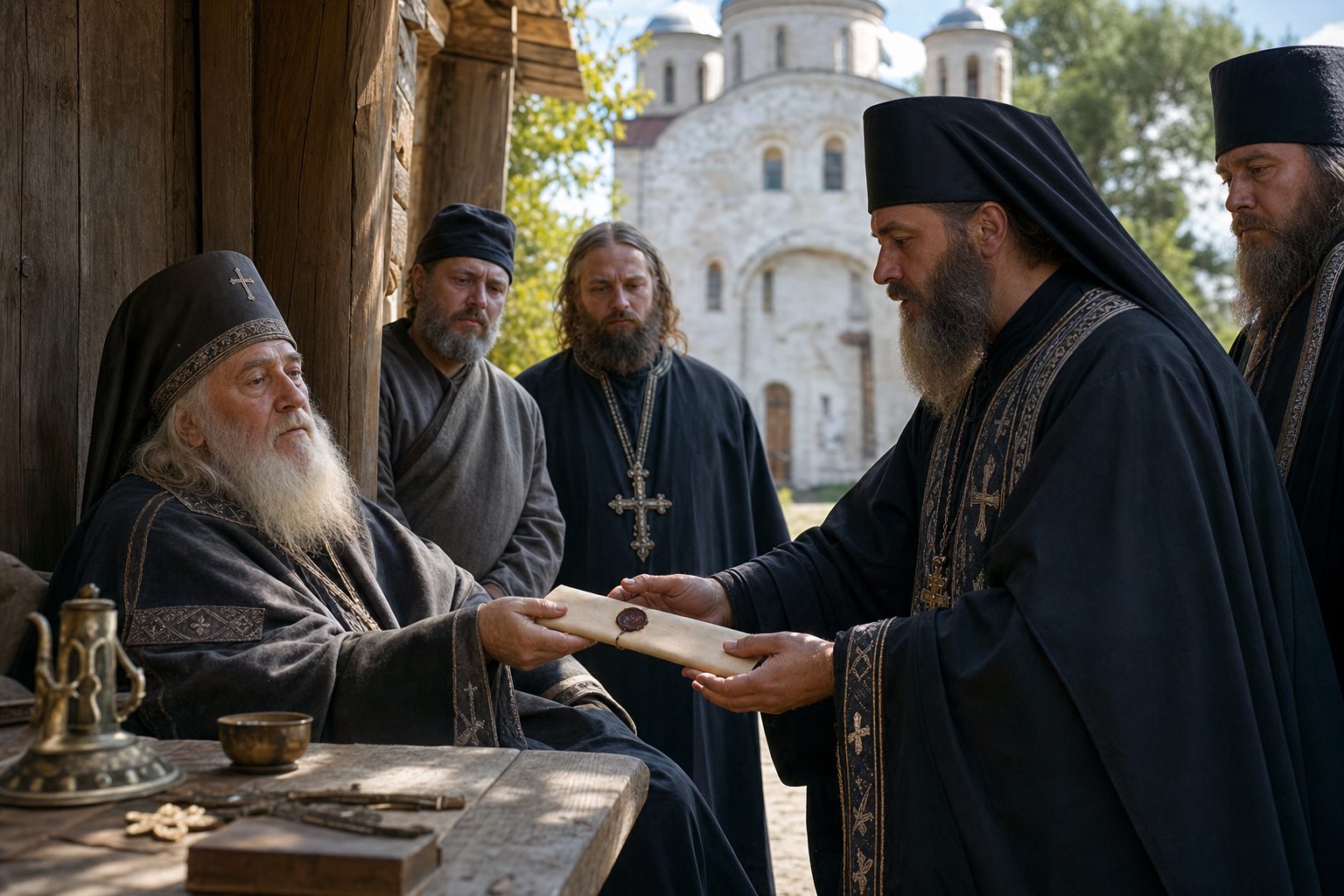
Foreseeing his own death, he wrote a charter, sealed it and handed it to Antony, the bishop of Chernihiv; at the same time, Constantine took an oath from Antony - after his death, having torn the seal and read the charter, to fulfill all that is written in it.
As soon as the blessed Constantine became a metropolitan [The death of the blessed Constantine followed in 1159], bishop Antony, taking the seal of the metropolitan, went with her to prince Sviatoslav Olgovich of Chernihiv [Svyatoslav Olgovich was prince from 1137 to 1165].
And when Antony had printed the letter, he read it in the presence of all, and there was written in the letter a strange and terrible thing,
And he said, When I am dead, let me not be buried; but bind my feet, and carry me out of the city, and give me for food to the dogs; I have sinned, and there is a rebellion because of me: let the hand of Jehovah, I pray thee, be upon me for this; and let me be afflicted, and let Jehovah turn away the contention and the strife of his people.
And the king said unto the bishop, Do as thou wilt. And the bishop, not daring to break the commandment of the bishop, nor his oath, did all that was commanded in the letter, and drew the dead man out of the city, and cast him into the field.
And the body of the metropolitan lay without a burial for three days; and all were filled with great fear and terror, seeing such a strange thing.
On the third day, prince Sviatoslav Ołgović, filled with the fear of God (great fear and terror attacked him after that terrible incident), ordered to bury the thrown body of the priest of God with decent honors.
And they brought his body to the city with great honor, and laid him in the church of St. Saviour, in Terem Krasnom, where was buried the new martyr, blessed Igor, prince of Kiev, killed by the Kievans.
In the days when Constantine's decent body was thrown out of the city of Chernigov, the sun darkened in Kiev and a storm rose so great that even the earth shook, thunder rose, lightning flashed, so that all the Kievans came into great fear and despair.
At this time, the thunder struck eight people with one blow - two priests, two deacons and four laymen.
1167), grandson of Vladimir Monomakh, was at that time in Powar near Vyshgorod; the storm destroyed the former tent near him.
Overcome with fear and remembering the death of the metropolitan (the prince of Chernihiv announced it to him through a goon), he sent a message to Kiev, to the church of St. Sophia and other cathedrals with the request to perform an all-night vigil in all churches.
And he said, This is the punishment of our iniquity, which Jehovah hath brought upon us.
All these fears and terrors were only in Kiev; in Chernigov, on the other hand, the sun shone brightly and there were no terrors.
After the decent body of the blessed Constantine was buried, there was complete tranquility in Kiev; all, amazed at what had happened, praised God, to whom glory belongs from us, now and forever.