The life of the holy father of our Vasianus, bishop of Lodi
To write about the lives of the saints who courageously armed themselves with God's help against the lusts of the flesh and to pass on their memory to future generations is useful for two reasons.
First, by remembering the heroic deeds of the saints, we believe that the saints will remember us before God; second, by describing the heroic deeds and courage of the saints, we encourage ourselves and others to imitate those deeds.
With this in mind, we will try to describe briefly the life and deeds of St. Bassianus, bishop of Lodi and confessor, and with the help of this God-pleaser we will offer a description of his deeds for which he was worthy to be a partaker of the heavenly kingdom.
His father, Sergius, governor of Syracuse, one of the first Greek colonies on the eastern coast of Sicily, founded in the 8th century BC.
He sent his son to Rome to study pagan philosophy, so that he could be the successor to his father's power and a skilled ruler of the citizens.
By nature wise and prudent, Vassian studied philosophy diligently and excelled in his studies.
At this time he heard about the name of Christ and about the life of Christians [From the further narrative it is clear that St. Bassian had heard about Christians as a child (the life relates that Bassian, as an infant, drew the sign of the cross on the ground); but in Rome Bassian became more thoroughly acquainted with Christianity
And then he wanted with all his heart to change the philosophy of the Hellenes to a Christian soul-saving flirtation; so he began to think, to whom of his father's servants (to whom he was entrusted) could he reveal the secret of his heart?
The Lord, however, not wanting to keep his soldier away from the work assigned to him, three times announced in a dream vision to a pious presbyter the desire and intention of the young man Vassian to become a Christian.
When he awoke from his sleep, the presbyter began to search all the schools of the city of Rome, trying to find in them the young man whom the Lord had shown him in a dream.
Finally, after a long search, the presbyter, with God's help, found the man he was looking for and asked him where he came from, who his parents were, and why he was living in Rome.
The presbyter was amazed at the wise and reasonable answers of the young man Vassanian, when he told about himself in detail, and realized that this was the young man he was looking for.
And he took him in, and told him of the vision which he had seen of God, and they both glorified God, and fell down at his feet, and besought him that he would make him a Christian.
The presbyter first began to teach the young man the truths of the holy faith and explained to him the mysteries of the Christian law.
Then the presbyter read it [All who were to be baptized in the early Church were ordinarily subjected to a preliminary proclamation - that is, an oral instruction in the truths of the Christian faith.
The proclaimed were permitted to be present only at the first (proscomedia) and second (liturgy of the proclaimed) parts of the divine liturgy; before the third part (liturgy of the faithful) the proclaimed were to leave the church, which was announced by the proclamation of the deacon: Proclaimed go out.
The time of the proclamation varied: it lasted from a few days or weeks to several months and even years.] and taught how he should conduct himself during holy baptism.
From that time on, Bassian often visited the honest presbyter with one of his oldest slaves, who was faithful to him in everything, learning Christian curiosity from the divinely inspired lips of his spiritual teacher.
After the announcement, Vassanian began to lead a harsh life: during the day he fasted and prayed, and at night he was either in prayer or reading books, sleeping only for a short time.
In the meantime, a long time passed, and finally the hour came for Vassanian's baptism, and Vassanian and his faithful slave went to the presbyter's house, where the holy baptism took place.
And when he had entered into the holy place, he saw a young man, whose face was as beautiful as the sun, who was ministering at the baptism, and holding the garment which the newly-baptized man should wear when he came out of the bath.
And he said unto him, Who art thou? and whence art thou? And he said unto him, I am sent to thee to cleanse thee from all thy uncleanness.
And when he was gone, the room was filled with a strange odor, which was felt for half an hour, so that all who were present thought they were in heaven, not on earth.
After his holy baptism, Vassianus began to lead an even stricter life, killing his young body and enslaving his spirit.
When they saw him abstaining, they were greatly astonished and perplexed, wondering why he ate so little and drank so little and slept so little at night and his countenance turned pale and his body fatigued.
When they saw this, they asked each other in disbelief: "Why is our master working himself so hard?"
And the oldest slave, who was faithful to St. Bassian and knew his secret, said to them, "Do not be surprised at this, for the philosophical doctrine can only be understood by those disciples who have despised all passions and are content only with what is necessary to sustain life.
Therefore know that our master, desiring to learn the highest of manners, has taken upon himself this abstinence and vigilance".
But the servants were not satisfied with this answer; they recalled that as a baby, Vassian sometimes drew a sign of a cross on the sand or made straw like a cross, for which his nurse often became angry with him.
Eventually, after various inquiries, the servants began to suspect that their master had accepted the Christian faith and was living in accordance with Christian doctrine.
They finally became convinced that Vassianus was a Christian when, after a night's vigil and hard work, the blessed young man fell asleep.
In his sleep, he began to say a prayer, calling upon God, the One in the Trinity, and asking Him to guide him to the path of glory promised to all who love Him.
Your prayer has been accepted by God and you have a good place in heaven".
After this event, the servants were finally convinced that Vassilian was a Christian; so they secretly, one by one, went back to Syracuse to their old master, the governor Sergius, with unpleasant news for him; they announced to the governor that his son, Vassilian, had accepted the Christian faith.
Sergius, an idolater, was deeply saddened by this and began to think about how to turn his son away from Christianity - by flattery or by threats.
And the king's servants departed from him, except one old and faithful servant, who was also a Christian, and his father desired to send new servants to take him from Rome, and bring him to him.
At this time, St. Bassian had to enter the night, the first song of the roosters [The early Christians, following the example of the ancient Jews, divided the night into four parts (three hours each), called watchmen.
The singing of the roosters, which was in the third watch, was called petlo proclamation or cockerel proclamation.] , in the church of St. John the Evangelist [Memory of St. John the Evangelist is celebrated on September 26 and May 8].
Here, praying as usual, he saw an honest man, dressed in gray, who said to him:
"Know, faithful confessor of Christ, that you must go with your faithful servant from here to the city of Ravenna [Ravenna was in the so-called Cespadano Gallia, on the shore of the Adriatic Sea Nature and art made this city a strong, almost impregnable, fortress, why Ravenna
It was considered a stronghold of Italy.
The Roman emperors, beginning with Honorius (395-423), chose it as their residence.] , for your father, who gave birth to you to the life of the flesh, intends to hinder the salvation of your soul; run away from here, lest he lead you astray from the right path.
For this reason the merciful God, who does not abandon his servants, sent me, his apostle, to tell you these things, so that the messengers of your father, finding you here, would not prevent you from escaping from here".
Blessed Vassianus, greatly rejoicing at the apostle's appearance, prayed many times to God, asking him not to abandon his help.
The next morning, they distributed all their belongings to the needy and, after receiving the blessing of their spiritual father, Gordian, left Rome for Ravenna in the evening.
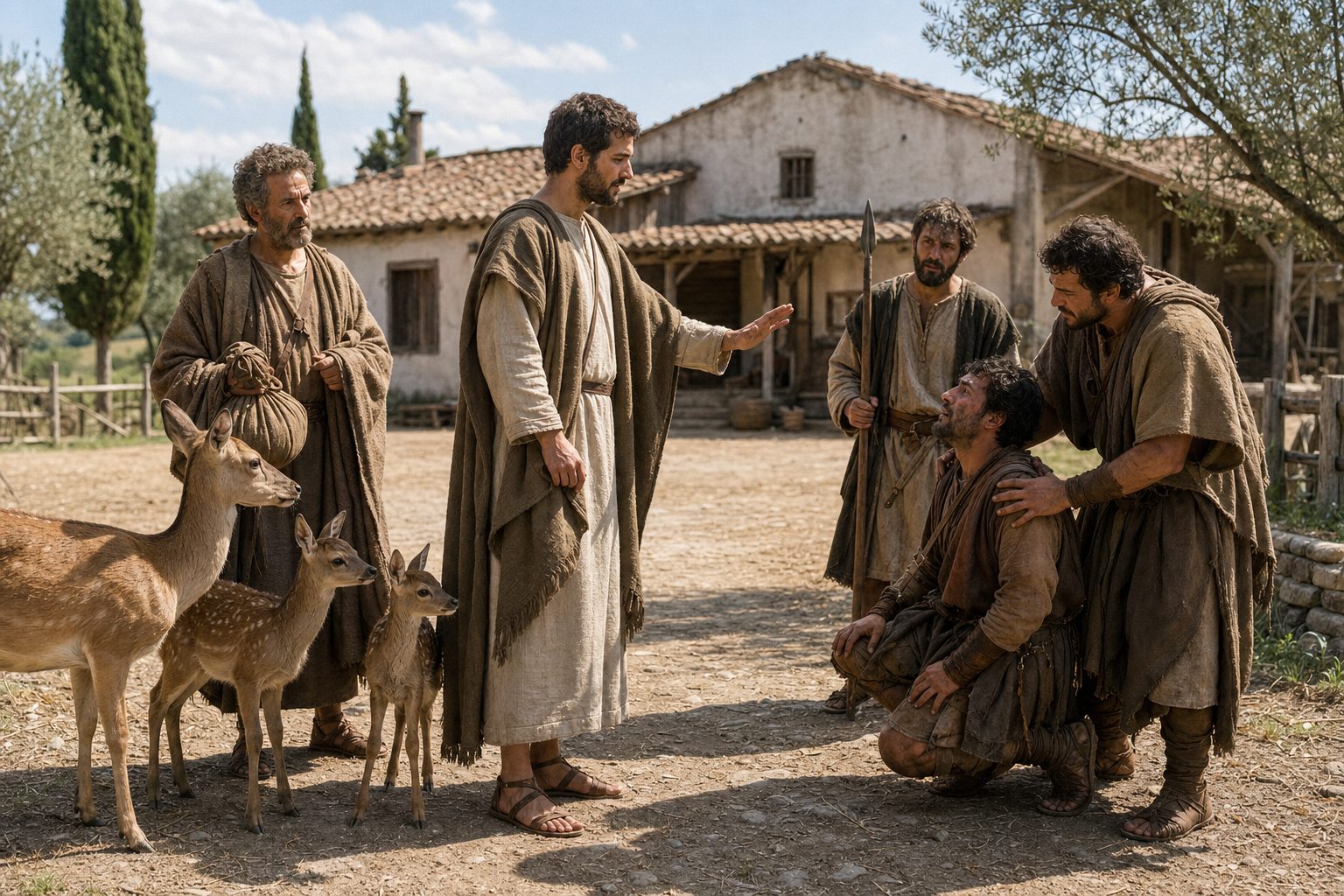
After a few days' journey on the road, St. Bassian saw a deer with two cubs; the animals were already exhausted and exhausted from the pursuit of the pursuing hunters.
Seeing this, the saint took pity on the deer and its cubs and said to her: "In the name of our Lord Jesus Christ, I command you to come to me without fear".
The deer, as if understanding the words, immediately became gentle, stopped and approached the saint without fear with her cubs.
When the hunters, who were chasing the deer, saw that the deer stood before the traveler gently and he stroked her hand, they were very surprised, wondering how the wildness of the animal could change so quickly into gentleness.
And one of the hunters, an evil man, said to his companions, Ye madmen, wherefore tarry ye, and take not the prey? And he took the stag out of his hand.
"Not I, but God Almighty commands you", said St. Bassian to the hunter, "do no harm to this wild animal or its young".
And the hunter with anger and presumptuousness dared to push away the hand of the pleasing of God; but at once, for his presumptuousness, the demon fell upon the cruel hunter, and tormented him exceedingly; and he fell to the ground in pain, and cried out with a terrible cry, and foamed, and became like a dead man.
The other hunters were terrified and trembled with fear and fell at the feet of the saint, begging for forgiveness with tears, fearing that a similar fate might befall them.
Vassilian ordered them to withdraw from that place, and he himself stretched himself out in the form of a cross to pray and, turning his whole mind to God, he began to pray: "God, the wonderful Creator of all things, the merciful God, the Savior of the fallen human race, who rejoices not in the destruction of the dead, but in the salvation of the living: forgive the one who lies in the grave.
Woe to the sinner and the wretched!
And when he had prayed, he came to him, and took him by the right hand, and said unto him, Satan, depart from me.
The One who lowered you from the heights of heaven into the abyss, commands you immediately to abandon the image of God - this man - and to withdraw to Tartarus [the dark abyss in the depths of the earth as the ancient Greeks understood it], where you will be tormented forever".
And it came to pass, as he was yet speaking, that the enemy of man came out of the man, and he smote him, and he was at the point of death; and when he was come to himself, he could not see with his eyes, and lay on the ground.
The saint again prayed to God and, after praying, he covered the hunter's eyes with the sign of the cross, which immediately opened, so that the hunter could see.
And all the people that were in the hunting-grounds, standing afar off, saw it, and came and worshipped the saint, and he that had been healed bowed down with them, and gave thanks to the saint, and healed him.
After this, all the hunters went home, the deer and its cubs were set free, and St. Vasianus himself and his slave set out on their further journey.
When the bishop saw his relative, he was very glad and especially when he learned that he believed in Christ and for the love of Christ he despised everything and began to wander.
At the request of Vassian, the bishop set aside a quiet place for him outside the city at the church of St. Apollinarius, the first bishop of Ravenna, ordained by the holy supreme apostle Peter.
(and Paul) is celebrated on 29 June.] and suffered in the reign of Vespasian [Emperor Vespasian reigned from 70 to 79 A.D.] for the name of Christ.
At this church, a very convenient place was found for Vassian: here, being alone, rejecting the world and everything worldly, he could work hard for God, fasting and praying.
The Lord immediately glorified his servant, and gave him the grace to heal by prayer and spiritual teaching, and he was respected, loved and praised by all around him.
And it came to pass at that time, that an order came from king Valentinian unto the governor of Ravenna, and to all the citizens of that city, to put to death a certain judge of the city, whose name was Bethany, because of the slander of the slanderers against Bethany before the king,
The crimes they allegedly committed.
When Bethany was bound and taken to the place where he was to be beheaded, he remembered St. Vasilian and said to himself: "Servant of God, Vasilian, by the grace of God, be my helper".
And the governor of the city, and a multitude of the people, were present, desiring to see the death of Bethany, and Bethany had bent down to cut off his head, and the executioner with the two-edged sword lifted it to strike the head of Bethany with force; but at that moment an unexpected thing happened.
And the sword fell out of the executioner's hand, and fell far off; and the executioner took the sword again, and took it with his hands, and lifted it up to cut off Beth-miah's head; and as he waved it, the sword fell out of his hands again, as at the first time, and fell away. And the executioner took the sword again in anger, and the same thing happened again.
And the governor of the city, thinking that the executioner would spare the condemned man for the reward he expected, removed the executioner and ordered another to cut Bethany, but the same thing happened to the other: the sword drew out of the executioner's hand three times with invisible force and fell away.
Then the governor of the city, amazed and afraid of what had happened, ordered the condemned man to be taken from the front seat, especially since the people demanded the release of Bethany, because the power of God protected him from death.
Bethany was thrown into prison and sent word to the king that the condemned man could not be cut down by two executioners.
Vitimnius did not hide, but, on the contrary, spoke of his intercessor, Saint Vasilian, whom he called in his prayer for help.
When he was released from prison, he went to the saint and, rubbing his feet, thanked him, but the holy pleasing of God commanded him to thank only God, who had saved him from death.
From that time on, all the inhabitants of the city came to respect the saint, viewing him as an angel of God and turning to him for help.
The Clergy and the nobles together begged the bishop to persuade St. Bassian to accept the priesthood, so that Bassian's prayer would be stronger before God.
He was ordained a priest, but not by his own will, and remained there for a long time until the death of his faithful servant, who had come with him from Rome.
On the seventh day after the ordination, during the liturgy, the saint, praying fervently for the repose of the soul of the newly ordained, heard a voice from heaven informing him that the soul of the deceased had received the mercy of God and was counted among the saints.
At that time, in the city of Lodi, in Liguria, Italy, a region inhabited by the Ligurians, a tribe of Celtic origin, the people of Liguria were called the Ligurians.
The inhabitants of this city fasted for three days and earnestly prayed to the Lord to send a worthy husband who, having ascended to the holy throne, could successfully govern the Church of Christ.
During a general fast and prayer to one of the presbyters of the cathedral church, named Clement, a virtuous and honest man, who fell asleep after church services, a luminous man appeared in a dream vision and said: "Know all that God has prepared for you in the bishops Presbyter Vassian, who resides in the city
Equal and adorned with God's provision".
When Clement awoke from his sleep, he summoned the most honest men of the clergy and the laity, and told them what the Lord had told him in a vision.
But before the messengers came to Ravenna, God revealed to Saint Bassian in a night vision that they were coming and told him to go with them.
And when Adam transgressed, he caused his soul and his offspring to die, and Allah is Exalted in Might.
So it is not for a man to oppose his Lord's will and break His commandments, but each one must, with all diligence, try to do what pleases the Lord and His commandments.
For this reason I also, not for want of honor, but for the needs of my brothers, by the command of God, do not refuse to accept the yoke that is laid upon me".
But the apostles, rejoicing at the consent of the monk, did not think of staying and resting, but wished rather to present to their city an invaluable treasure, sought to set out again and begged the saint to go with them as soon as possible; so in the evening the monk and the apostles set out.
When they came to Lydda, a man who was mute and could not speak was there.
Immediately the man stood up and his body was restored, and his tongue was loosed, and he praised God.
For the consecration of St. Bassian to the rank of archbishop, St. Ambrose arrived in Lodi.
the life of St. Ambrose on 7 December.] from Mediolanum [Medilanum - an ancient city of the Gallia of Ciisalpina or the present northern Italy - the center of sciences and arts; now - the main city of the Italian region of Lombardy.] and the above-mentioned relative of St. Vasiano Ursus from Ravenna.
On the first day of January, the consecration of his chosen husband, Vassanian, as bishop took place, which brought great joy and celebration to the whole city.
To St. Ambrose he showed a great love of the Holy Spirit, and from Ambrose he had a similar love, which was expressed in their frequent kind letters to each other.
After some time, the patron saint of Christ, Vassian, built a magnificent temple in the eastern suburbs of the city in the name of the holy apostles and invited St. Ambrose of Mediolanum and St. Felix of Comana to consecrate this temple.
Asia, you know.
Now at the site of this city is the village of Gumenek.] (Urs Ravenniysky at this time had already rested on the Lord).
And it came to pass at the time of the consecration of the temple, that there stood a certain young woman in the midst of the people, who was possessed with a demon, and the devil cried out with a loud voice, saying, Why have ye rebelled against me, ye men of God?
Is it not enough for you that you have taken away from us the right to a man, and you are driving us out, and those over whom we had the right to rule?
When the servants of Christ heard the devil's cry, they knelt down and prayed more earnestly to the Lord. While they were praying, the demon could not bear the power of their prayer, and he threw the boy to the ground and cried out loudly and left him.
The holy ones took the girl up from the ground and brought her back to her parents, saying: "Give thanks to Jehovah for clearing your daughter of the demon's torment".
After the consecration of the church, a meal was arranged in the glory of God, at which the saints discussed what was useful for the Church of God.
One day, during the harvest season, a young man was gathering sheaves among the harvesters, and a serpent bit him, and he died.
His parents, grieving over his death, brought him to be buried in the church built by Blessed Vassianus in honor and glory of the holy apostles, where at that time the archbishop of God, Vassianus, was also present.
During the singing of the customary funeral canon, the cry of the parents over the boy began to drown out the voices of the singers. The priest of God, feeling sorry for the weeping, ordered everyone to leave the church; then he remained alone, fell to the ground before God with tears and begged Him that the Lord would command the soul of the boy to return to the body.
And when he prayed, the dead man's body began to move a little, and then more and more, and he arose from his prayer, and took the boy by the hand, and commanded him to rise; and the boy awoke, and opened his eyes, and called his mother, and arose.
And they opened the doors at once, and saw the young man alive, and were astonished.
And after giving thanks to Almighty God, and giving instruction, he sent them all away in peace.
The Archbishop of God, Vassian, upon learning of the illness of his beloved, of the Holy Spirit, father and friend, hastened to go to Medeolan to visit the sick man, where, seeing Ambrose on his sickbed, he stayed to minister to him, pray with him and comfort him with hope in Christ.
St. Ambrose had a vision in which he imagined that he saw our Lord Jesus Christ coming toward him with a bright face and a kindly smile.
Then Vassian, realizing that the hour of the death of St. Ambrose was approaching, began to weep and rejoice together.
He rejoiced that his holy husband was departing to Christ, who called him, and he wept that he had lost his dear friend in this worldly life; but he had a firm hope in Christ to meet him in the next life and to be with the dead in the ranks of the hierarchs.
After the death of St. Ambrose, Vassian and all the inhabitants of Mediolanum mourned the saint and buried his holy body with honor.
After this, Vassian went to his city, where he began to offer a bloodless sacrifice before the Lord with a prayer for the repose of Ambrose, although he was quite sure that his soul was buried with the saints; but prayer and bloodless sacrifice about the saints are not fruitless.
If prayer to a saint is not helpful, it returns to the praying person's belly, benefiting him, as David said: "My prayer has returned to my belly". - Ps. 34:13.
And after a long time, when he was come into the city, he saw a man in the market-place, who weighed and hanged goods, and he was an unrighteous man, deceiving many, and making a profit by it.
And he saw on the scales a little Ethiopian dragging a pair of scales, and he said unto them, Seest thou anything strange? And they said, We see nothing.
Then the saint prayed for others to be able to see what he had seen.
And the eyes of Clement the bishop and of Elvonius the deacon were opened, and they saw the same thing that the bishop of God had seen, even a little Ethiopian sitting on the scales, and doing according to the commandment of the weigher.
(Ps. 61:10) The saint called the weigher and asked him: "By what unrighteous measure do you increase the weighing and deceive the merchants?"
And he said, I have done no wrong. And he stretched out a Cushite's weight, and said, Behold, he shall come in to thee in a moment, and break thy flesh, and take away thy life in pain.
And when he had recited the Qur'an to him, he said, "O my people!
After returning to his hometown, the God-pleaser engaged in the usual works of God-pleasing and care for the flock. He lived in the hierarchical rank for five years and peacefully retired to the Lord, to whom he had worked faithfully and truly, at the age of ninety.
The faithful sheep buried their pastor with honor in the Apostolic Church he had built, and wept much at the loss of such a father.
He died a saint during the reigns of Honorius in the West and Theodosius in the East, son of Arcadius.
He was a man of miracles, both in life and in death, who by his prayers and the grace of our Lord Jesus Christ was able to heal the sick by miraculous powers from his tomb. To him be glory and honor now and forever. Amen.
I 'm going to have to get back to you .