The Passion of St. Patrick the Martyr and with him three presbyters: Acacia, Menander and Polyene.
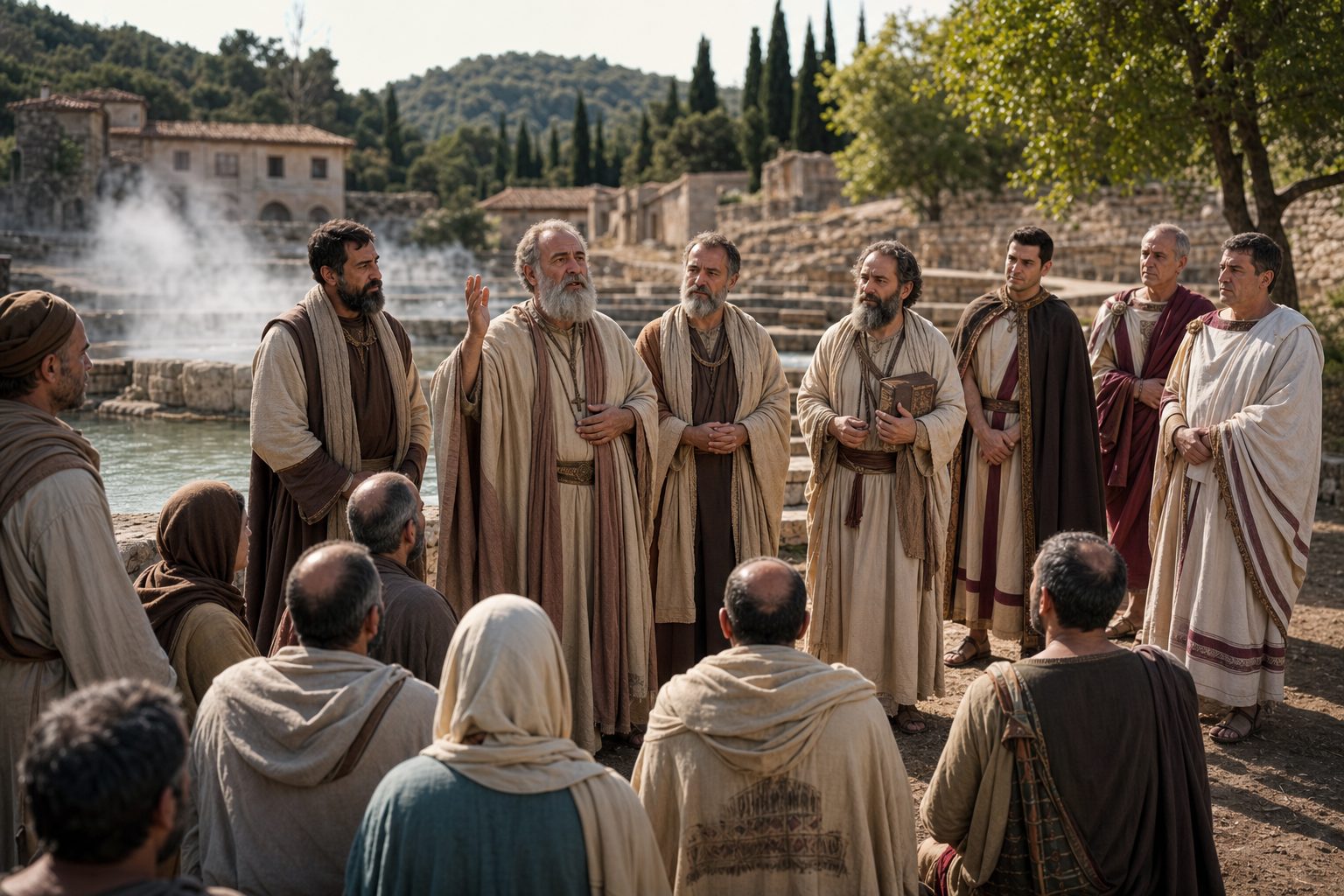
On the 19th of May, the episcopal see of St. Patrick was in the city of Prussia, in the province of Bithynia. One day he began openly to denounce the errors of the heathen and to preach the faith of Christ; his preaching converted many heathens to Christ; for this he was taken by the heathen, together with the three presbyters, Acacius, Menander, and Polyene, and brought to the question of the Bithynian igumen Julius, a most zealous idolater.
The latter, going at that time to the warm springs [Hegemon Julius went to the warm springs with healing purposes. These springs, indeed, possessed healing properties, due to the admixture to their waters of various mineral substances. Many such springs were known in antiquity in Italy 2 on the island of Sicily.] , ordered to lead himself and a Christian bishop with his presbyters, imprisoned in iron chains.
Arriving at the springs and washing in them, Julius offered sacrifices to his unclean god Asclepius and the vile goddess Sotyria, a common name for the goddesses Athena and Aphrodite.
And when he had called St. Patrick and the elders, and sat in the judgment-seat, Julius said unto him,
"O madman who calls on Christ and believes in false stories, behold the greatness of the power of our gods, behold the healing power of these springs which they have given us, and first of all understand the greatness of the power and the greatness of the mercy of our father Asclepius. If you wish to escape from bondage and torment and live in peace in your own country, fall down, worship him with humble supplication and offer him a sacrifice".
"Oh, how much evil you have spoken in your short speech, Aegemon!" said Aegemon indignantly, "What crime have I said? In what can you accuse me, you wretched one? You yourself must confess what is obvious to yourself without any deception or trickery: do you not see with your own eyes the healings given from the warm springs by the power of our almighty gods?" St. Patrick answered.
"Excellent Aegemon, if you want to know the truth about the origin, the end, and the healing power of these hot springs, I will tell you all about it, if you will listen to me gently". Aegemon said, "Even though I don't think of hearing anything else from you but a fairy tale full of myths, still speak, and let me hear what you have to say". The saint said, "Don't make up, but I want to tell you the truth". Aegemon said,
"What other source of the power of warm waters can you point to than the power of our gods?" The saint replied, "I am a Christian, and anyone who professes this sacredness of Christianity and worships the one true God can by his reason know the mysteries of God; therefore I, though a sinner, but professing myself a servant of Christ, know that I can tell you the truth concerning these waters".
"Are you so bold and foolish as to think yourself wiser than our philosophers?"
"For the wisdom of this world is foolishness with God. For it is written, 'He catches the wise in their craftiness.'" (1 Cor. 3:19) Christ our Lord, praising his Father, said: "I publicly praise you, Father, Lord of heaven and earth, because you have hidden these things from the wise and intellectual ones and have revealed them to babes".
"Thou speakest a strange thing, but tell me, by whose power and arrangement these warm healing waters flow?" As for me, I attribute it to the handiwork of our gods, who thus delighted to help men.
And before I speak, I beseech thee, I beseech thee, cause the fence to be taken down, that all may hear my words. And I beseech thee, let the fence be taken down, and the people be filled round about.
The same God, who created the heavens from water and the earth from water, and established the earth on the water and the water.
He created all that is in the heavens and the earth, and then He made for them two destinations, and then He made for them two destinations, and then He made for them two destinations.
He has made the first of them a light, and He has made the other a darkness. Those who are pleased with Him will be in the light, and those who are disobedient will be in the darkness.
And those who are in darkness shall be tormented for ever, and He will separate between them, and He has created each and has decreed for it a measure.
And fire and water are above the firmament of heaven, and under the earth; and the water that is seen on the earth, being gathered into its containers, is called the sea (Gen.1:10), and that which is under the earth, is called the deep; and from this deep, for the benefit of men that dwell on the earth, and for the benefit of all living things in general, the waters are sent upward through the earth's bowels, as by water pipes; and coming up to the surface of the earth, they form either springs, or
Wells, or rivers.
There is water that flows warm to the surface of the earth, and there is water that flows cold to the surface of the earth, and there is water that flows cold to the surface of the earth, and there is water that flows cold to the earth.
Thus, the underground fire is intended to torment wicked souls; the water of the underworld, which has turned into ice, is called a tartar [Speaking about tartar, St. Patrick applies to the understanding of the pagans around him and explains their own view of tartar. Tartar according to ancient Greek mythology is a dark abyss as far from the surface of the earth as the sky is from the earth.
According to the Greeks, Tartarus was surrounded by a triple layer of darkness and an iron wall; it served as a place of imprisonment for the fallen gods.] in which your gods and those who worship them will suffer endless torment, as one of your poets sang, saying: "The (finite) boundaries of earth and sea are nothing but the extreme boundaries, where Iapetus and Saturn [Iapetus - one of the titans - sons of Uranus (heaven) and Gaia (earth) ] are.
According to Greek mythology, Iapetus (together with Cronus) rebelled against the supreme god Zeus, for which he was the last to be imprisoned in Tartarus.
According to the Greek mythology, Saturn, like Iapetus, was cast down by Zeus from heaven and imprisoned for a time in Tartarus.] (these are the names of your gods) do not delight in the brightness of the bright sun, nor in the cool winds"; in other words: your gods, who dwell in darkness and in Tartarus, are not illuminated or warmed by sunlight, and those who dwell in the fire are not cooled by the wind.
The heavens are higher than the earth.
And that under the earth fire is prepared for the wicked is proved by the boiling springs which come out from under the earth in Sicily. When the agemon heard these words of the saint, he asked him:
St. Patrick replied, "It is Christ, and no one else, who is the Creator of all things; for it is written, 'All things came into being through him, and without him nothing came into being.'" (John 1:3) And again, "For all the gods of the peoples are nothing, but the Lord of the heavens created them". (1 Chronicles 16:26) Hegemon again asked the saint, "Do you call Christ the Creator of the heavens?"
"When I behold thy heavens, the work of thy fingers, the moon and the stars which thou hast ordained" (Psalm 8:4).
"I know the power of my Christ; I know that He can keep me whole and unharmed from these waters, if He wills; and I myself would like by means of these waters to be freed from this temporal life, to live forever with Christ; nevertheless let not my will, but His holy will be done over me, without which not a hair of the head of man will fall, without which not a bird will fall into the net.
But let all who hear me now know that the punishment of those who worship you as a god will be eternal torment in the underworld, in unquenchable fire and Tartarus.
When the saint was thrown into the water, drops of water gushed from the spring, burning like sparks of fire, and, reaching those standing around, caused them severe burns. But St. Patrick was unharmed in those waters, as in a cool place, and rejoicing, he praised Christ God.
And he lifted up his hands to heaven, and said, O God, King of all things, and Lord of all things visible and invisible, who hearest all that call upon thee in truth,
And when he had finished praying, he bowed his head and died a martyr's death, and his three holy presbyters, Acacius, Menander, and Polynius, were also crucified with him, and they all stood before Christ in the glory of the saints.
And St. Patrick was slain with his ministers on the nineteenth day of the month of May [the time of their death is not known exactly, it is supposed to have followed the middle of the fourth century] and received the crown of victorious honor from Christ Jesus our Lord, to whom belong honor and glory with the Father and the Holy Spirit, now and forever, and unto the ages of ages.
Who shines with the goodness of the priesthood, and the blood of suffering embellishes, with the suffered with you, Patrick, Christ to come, remember us as an honest sufferer.